Gazing at the Stars – The Fascination of Astrophotography
Museum-quality archival print available in the following sizes:
60 × 45 cm (23.6 × 17.7 inches), edition of 25 + 3 artist's proofs, price €6,000
80 × 60 cm (31.5 × 23.6 inches), edition of 15 + 2 artist's proofs, price €9,000
120 × 90 cm (47.2 × 35.4 inches), edition of 10 + 2 artist's proofs, price €13,000
180 × 135 cm (70.9 × 53.1 inches), edition of 5 + 2 artist's proofs, price €22,000
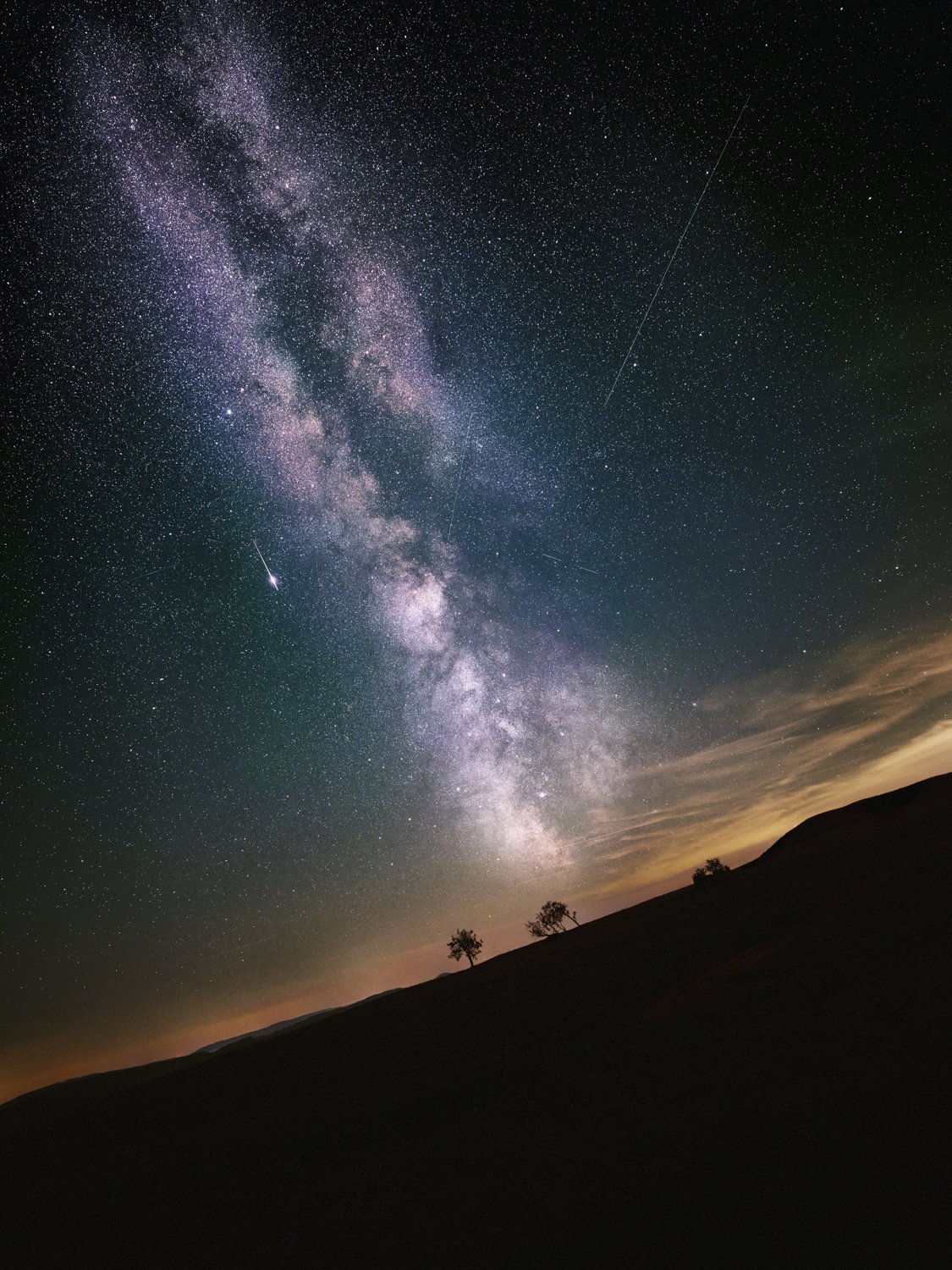
In *Milky Way*, photographic artist TINA TRUMPP presents a striking fusion of photographic art, landscape, and a cosmic perspective. Taken in one of the darkest places in Germany, the photograph offers a clear view of the vastness of the Milky Way, which stretches across mountains and tree lines.
In the foreground, the landscape is still bathed in the warm, red light of the sunset, which gently highlights the silhouettes of mountains and trees. Above, the night sky unfolds in all its depth—studded with countless stars. On the left side of the image, this moment is complemented by a visible shooting star, a fleeting event within an already fleeting moment.
This work explores the relationship between humanity and the universe. Here, landscape photography becomes a medium that puts our own scale into perspective: the infinite expanse of the Milky Way makes us feel just how small—and yet how connected—we are within this cosmic space.
Here, too, TINA TRUMPP characterized by a combination of clear composition and emotional depth. The juxtaposition of warm, earthy light and a cool, starry world creates a tension between intimacy and infinity, between the known and the unknown.
As a fine art print, "Milky Way" is aimed at art collectors and galleries who appreciate contemporary photographic art with a conceptual message and aesthetic clarity. The work points to what lies beyond our perception—to the vastness, the unknown, and the quiet fascination of the universe.
As night falls and the lights of the cities slowly fade, a window opens onto another world: the universe. Astrophotography makes this invisible spectacle visible and captures moments that often remain hidden to the naked eye. It is more than just a photographic genre—it is a fusion of science, technology, and artistic expression.
Astrophotography starts with patience. Unlike traditional photography, it’s not about capturing the perfect moment in a fraction of a second. Instead, astrophotographers work with long exposure times, precise planning, and often hours of preparation. The Earth’s rotation, light pollution, and the weather are just a few of the challenges that must be overcome.
But that is precisely what makes it so appealing. Anyone who takes up this discipline will discover the sky anew. Constellations become familiar landmarks, and planets become regular companions in the night sky. With a camera, you can reveal structures that remain hidden to the naked eye: the delicate arms of distant galaxies, luminous nebulae of gas and dust, or the fine details of the Moon’s surface.
From a technical standpoint, astrophotography requires specialized equipment. In addition to a high-sensitivity camera, sturdy tripods, special tracking systems, and high-quality lenses play a key role. However, even beginners can achieve impressive results using simple methods—such as by photographing the Milky Way or star trails, which reveal the Earth’s rotation.
However, in addition to technical skill, a creative eye is crucial. The choice of composition, the inclusion of landscapes or silhouettes, and post-processing play a decisive role in determining the impact of an image. This results in photographs that do more than simply document; they evoke emotions—a sense of wonder, awe, and sometimes even humility in the face of the cosmos’s infinity.
Astrophotography is, ultimately, an invitation to pause and reflect. In a world that’s spinning ever faster, gazing at the stars reminds us just how vast the universe is—and how small we are within it. At the same time, however, it also shows us that we are part of this universe, connected to the stars whose light has often traveled for millions of years before reaching our camera.
Gazing at the stars is, then, a journey—not only through space and time, but also within ourselves.
A particularly striking example of this is my own photograph of the Milky Way featuring a shooting star —taken during a short trip to the Wasserkuppe, one of the darkest places in Germany—which shows just how magical and unique gazing at the stars can truly be.